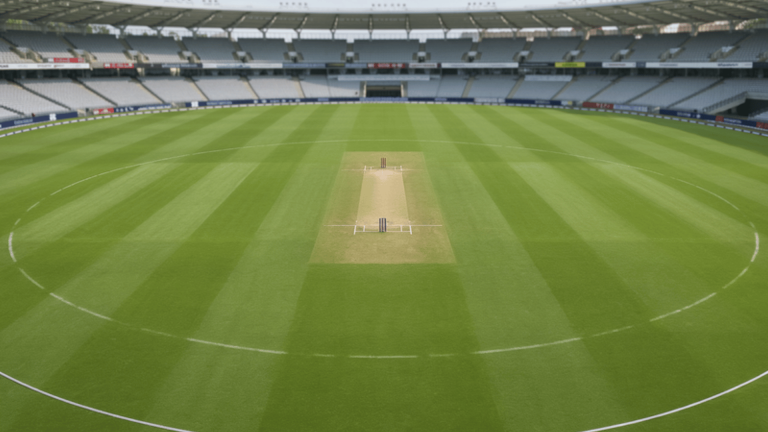
Death Over Field Settings, And Why They Look Odd
Five fielders out, four in, and singles conceded everywhere. The death field stops trying to take wickets and starts trying to control a number.
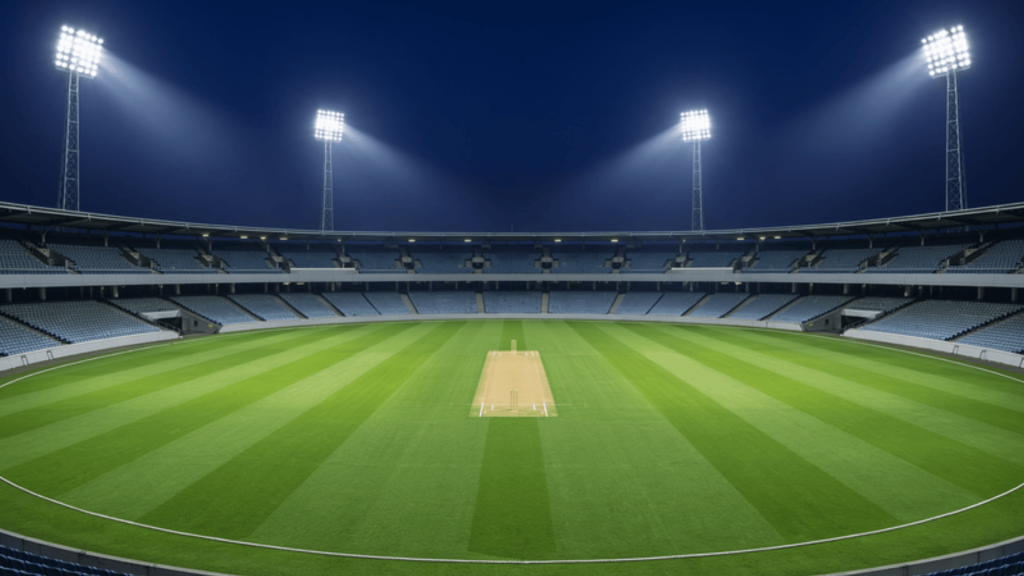
At the end of a limited overs innings the field stops looking like a cricket field. Nobody is in a catching position, there are gaps where the textbook says there should be fielders, and two players are standing in places that appear to serve no purpose at all.
It looks odd because it has stopped being a field designed to take wickets and become a field designed to control a number.
The Constraint That Makes It Look Strange
At the death a captain may have five fielders outside the circle. Eleven players, minus the bowler and the wicketkeeper, leaves nine to place. Five go out. Four stay in.
Four fielders inside the circle is not enough to stop singles. It is barely enough to cover the straight drive and the push into the covers. So the captain accepts, before the over starts, that singles are available almost everywhere, and spends his entire allocation on the boundaries he believes are actually in play.
That acceptance is what makes the field look wrong to anyone used to watching the first fifteen overs.
A Common Shape, Position By Position
There is no single correct death field, but most of them are variations on one arrangement against a right hander.
| Position | In Or Out | What It Is Actually Doing |
|---|---|---|
| Third | Out | Covering the edge, the ramp and the late cut |
| Deep point | Out | The wide yorker squeezed square |
| Long off | Out | The straight hit against the fuller ball |
| Long on | Out | The same shot, other side of the sightscreen |
| Deep midwicket | Out | The slog, the pull, the biggest percentage shot |
| Mid off | In | Stopping the easy straight single |
| Cover | In | Blocking the push for one |
| Square leg | In | Blocking the flick, and run out cover |
| Short fine leg | In | The glance, and the top edge of the pull |
Read down the out column and the logic is visible. Every boundary fielder is covering a different shot, and no two of them cover the same one. That is the whole design principle. Doubling up on an area is a luxury a captain cannot afford with five.
The Two Plans, And Why The Field Tells You Which
Death bowling comes down to two broad approaches, and the field is set for one or the other before anyone bowls.
The wide yorker plan aims at the batter’s feet outside off stump, taking the leg side away. A field set for it has deep point squarer than usual and often a second fielder on the off side boundary in front of square. Long on may come squarer to deep midwicket, because the straight hit is less available if the ball is wide.
The hard length plan bowls into the pitch at the body, inviting the pull. A field set for it has both square boundaries protected, fine leg pushed back, and often nobody straight at all. If you see long off vacated at the death, somebody has decided the batter is going to be bowled at ribs height.
The useful thing for a viewer is that the field is set first. You can know what is coming before the bowler reaches the crease.
Short Boundary Thinking
Grounds are not symmetrical. Most have one square boundary noticeably shorter than the other, and at the death that difference overrides almost every other consideration.
The usual response is to bowl so that the natural shot goes to the long side, which means the line changes depending on which end the bowler is at and which way the batter is facing. A right hander with the short boundary behind square leg will be bowled wide outside off all over. The same batter with the short side at deep cover will see the ball at his hip.
This is also why captains sometimes seem to leave an obvious gap. If the gap is on the eighty metre side and the fielder has been moved to the sixty metre side, that is not an oversight.
The Fielder Who Looks Wasted
Third is the position that confuses people most. It sits behind square on the off side, a long way from anything a batter is deliberately trying to do, and for most of an innings it is empty.
At the death it is almost always occupied, for two reasons. The ramp and the scoop are now standard shots, and both of them go there. And the wide yorker produces a thick outside edge far more often than it produces a clean square drive, with the edge travelling fast and flat into exactly that region. A captain who leaves third vacant in the eighteenth over is giving away boundaries off deliveries the bowler executed correctly.
Left Handers, And The Problem Of Pairs
A settled death field is built for one batter. The moment a single is taken, the other batter is on strike, and if they are a left hander the entire arrangement is mirrored incorrectly.
Captains deal with this in one of two ways. Either they set a compromise field that is slightly wrong for both, keeping square boundaries covered on both sides and giving up something straight, or they accept the rotation and move two or three fielders every single ball. The second looks chaotic and costs time, which in T20 internationals carries a real penalty if the over rate slips.
A left and right pair at the death is worth more than it appears on the scorecard, and it is one of the few things a batting side can engineer deliberately by choosing who goes in at the fall of the sixth wicket.
What To Watch
Look at the field before the bowler starts his run, not after the ball is hit. Count the fielders behind square on the off side. If there are two, a wide yorker is coming. Then watch whether anything moves between deliveries. A captain who sets a field and leaves it alone has a plan he believes in. A captain who adjusts every ball is reacting, and reacting is how the last four overs get away from a side.