
Fielding Restrictions, Circle By Circle
Thirty yards of white paint decides the shape of every limited overs innings. Here is exactly who is allowed where, and what each phase does to the contest.
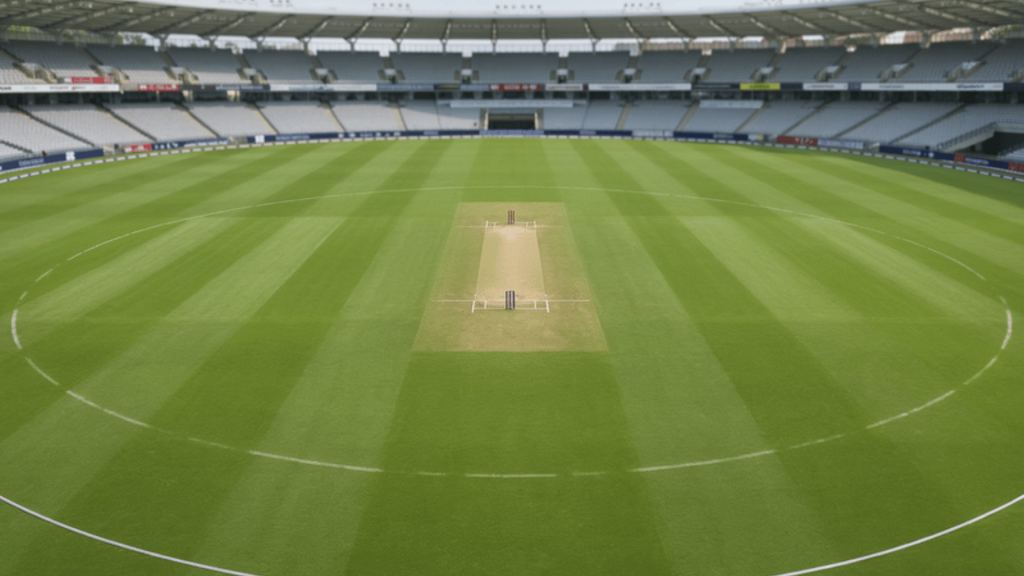
The white line that loops around the middle of a cricket field is the most consequential piece of paint in the sport. Everything about how a limited overs innings is shaped comes back to how many players a captain is allowed to put outside it.
The rules themselves are short. What they produce is not.
The Circle Itself
The fielding restriction area is not a circle at all, strictly speaking. It is drawn as two semicircles of thirty yards, centred on the middle stump at each end, joined by two straight lines running parallel to the pitch. On most grounds it is marked by white discs pushed into the turf rather than painted, which is why you sometimes see a fielder arguing about whether a foot was inside or out.
Thirty yards is a little over twenty seven metres. It is close enough that a well struck drive clears it before anyone can move, and far enough that a mishit will usually be caught inside it.
Who Is Allowed Where
The restriction applies at the instant of delivery, not during the ball. A fielder can start inside the circle and sprint out as the batter plays, and often does. What matters is where everyone is standing when the bowler lets go.
| Format | Phase | Overs | Allowed Outside |
|---|---|---|---|
| ODI | Powerplay 1 | 1 to 10 | 2 |
| ODI | Powerplay 2 | 11 to 40 | 4 |
| ODI | Powerplay 3 | 41 to 50 | 5 |
| T20 | Powerplay | 1 to 6 | 2 |
| T20 | Rest of innings | 7 to 20 | 5 |
In a shortened match the phases shrink proportionally rather than disappearing, and the scorers work from a published table so that a twenty two over innings still has three recognisable blocks.
The Other Restriction, Which Applies Always
Separately from the powerplays, no more than five fielders may be on the leg side at the instant of delivery, in any format, in any over. This one is older than the circle and it exists for a different reason. It was brought in after bowling sides worked out that packing the leg side and bowling at the body made batting close to impossible. Breaching it is a no ball.
What Two Fielders Outside Actually Does
A captain with only two players permitted in the deep has to choose which two boundaries to protect, and in doing so tells the batter where the gaps are. There are five or six standard answers, and experienced batters read them instantly.
- Both in behind square on the off side. The captain is bowling a fourth stump line and expecting the cut and the slash. Straight hitting is unguarded.
- One at deep square leg, one at deep point. A short ball plan, usually against a batter who pulls hard but not often.
- One at third, one at fine leg. Protection against the edge and the glance, which means the captain has accepted singles and is playing for the wicket.
- Both straight, at long on and long off. Almost always a spinner inside the powerplay, which is itself a statement.
Whichever he picks, four boundaries are open. That is the whole point of the phase. It is not that scoring is easy, it is that the field cannot cover the ground, so every ball offers a bargain between risk and reward that does not exist later.
Why The Middle Feels Different
Going from two fielders outside to four does not sound dramatic. In practice it changes the game more than any other moment in a one day innings. Those two extra bodies are usually placed at deep midwicket and long off or deep cover, and between them they shut the two highest percentage boundary options available to a set batter.
What is left is the single. A ring of four or five fielders inside the circle, saving one, with four out. Strike rotation becomes the entire contest, and this is where dot balls start to matter, because a batter who cannot find the gap for one is forced eventually into finding the gap for four.
The Last Phase, And The Over Rate Catch
Five outside is close to a conventional field, and it is the only phase in which a captain can genuinely protect every boundary he thinks is in play. It is also the phase in which bowling has the least margin, because the two fielders left inside the circle beyond the keeper and bowler cannot cover a mistake.
In T20 internationals there is a sting attached. A fielding side that has not bowled its overs on schedule is required to bring an extra fielder inside the circle for the remainder of the innings, which leaves only four outside instead of five. It is an in game penalty rather than a fine after the fact, and it has changed how sides manage their time between overs.
Three Things People Get Wrong
- The circle is not about the batting side. It restricts the fielding captain. Batters do not gain a right to anything, they simply face a field that cannot be fully defensive.
- Fielders may leave the circle during the delivery. The count is frozen at the moment of release, which is why you see the ring breaking outwards as the stroke is played.
- The wicketkeeper and bowler count as fielders. They are almost always inside, but they are part of the eleven and not exempt from the leg side limit.
Watch one over with your eyes on the field rather than the ball and the structure of the innings becomes visible. The captain is making an argument every delivery about where he thinks runs will come from, and he is allowed only so many words to make it.
Where The Circle Came From
Fielding restrictions were not part of cricket for the first century of its organised life. They arrived because one day cricket exposed a flaw that first class cricket never had to deal with. In a format with a fixed number of overs and no requirement to take wickets, the optimal defensive field is simply everyone on the boundary, and a side that does that can strangle an innings without ever threatening to bowl anybody out.
The first experiments came in Australian domestic cricket at the start of the nineteen eighties, and the idea reached international one day cricket as a standing rule in 1992. The name powerplay was attached in 2005, along with a period of heavy tinkering in which blocks could be taken at different times and even chosen by the batting side. That version was abandoned in July 2015, when the structure settled into the three fixed phases used today. The same revision removed an older requirement that two fielders stand in close catching positions during the opening overs, which had quietly stopped making sense once captains were setting attacking fields anyway.
What survives is the simplest version of the idea anyone has tried. No elective blocks, no negotiation, just three numbers and a line on the grass.